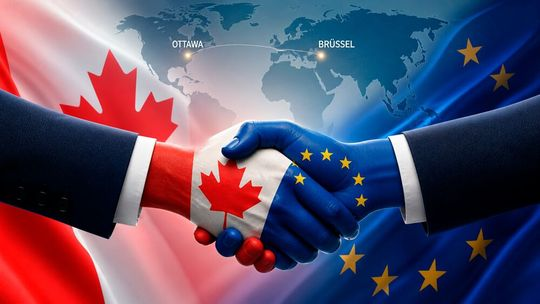
Is Canada joining the European Union? Is Canada already part of the EU? Why doesn’t Canada join the EU? And what exactly is the relationship between Canada and the European Union?
These questions have attracted attention as Canada and the European Union have significantly expanded their cooperation in recent years. In 2025 and 2026, Canada and the EU strengthened their relationship in areas including trade, defence, critical minerals, energy, digital policy and international security. Canada even became the only non-European country to participate in the EU’s Security Action for Europe (SAFE) instrument.
However, closer cooperation does not mean Canadian EU membership.
As of September 2026, Canada is not a member of the European Union, and there is no EU accession process for Canada. Canada remains an independent country with its own government, laws, currency, immigration system and international relationships.
Table of Contents
ToggleIs Canada joining the European Union?
No. Canada is not currently joining the European Union.
There is no Canadian application for EU membership and no formal accession negotiations between Canada and the EU.
Under Article 49 of the Treaty on European Union, a European state that meets the required conditions can apply for EU membership. The EU describes membership eligibility as applying to a European country that respects EU values and meets the required political and economic criteria.
This is important when considering Canada because Canada is geographically located in North America, not Europe.
Therefore, the idea that Canada is becoming the EU’s 28th member in 2026 is not supported by the current formal EU enlargement process.
Canada’s current approach is instead based on partnership and cooperation with Europe, rather than becoming part of the European Union.
Is Canada a part of the European Union?
No. Canada is not part of the European Union.
The European Union currently consists of 27 member countries. Canada has a separate relationship with the EU as a non-EU country.
Canada does not participate in EU institutions in the same way as EU member states. For example, Canadian citizens do not elect Members of the European Parliament as EU citizens do, and Canada does not have representatives participating as a member state in the EU’s decision-making system.
Canada also maintains its own:
- Parliament and federal government
- Canadian dollar
- immigration and citizenship system
- foreign policy
- taxation system
- trade policy
- national laws
- border and customs system
At the same time, Canada works closely with European institutions and individual European countries.
The EU itself describes Canada as one of its strategic partners, with cooperation covering political, economic, environmental and security issues.
So, the simplest way to understand the relationship is:
Canada is not inside the EU; Canada is a close partner of the EU.
Why doesn’t Canada join the EU?
There are several reasons why Canadian EU membership is not the current model of the relationship.
1. EU membership is designed for European states
The EU treaties establish a membership route for European states that satisfy the EU’s political and economic requirements. Article 49 specifically refers to a “European State” applying to become a member.
Canada is a North American country geographically separated from Europe by the Atlantic Ocean.
This makes Canada fundamentally different from countries that have traditionally pursued EU membership.
2. Canada already has its own international framework
Canada is an independent sovereign state with its own political institutions, currency, laws and international agreements.
Joining the EU would therefore involve a much deeper form of political and economic integration than the cooperation Canada currently has with Europe.
EU membership involves accepting extensive EU rules and obligations. The European Commission explains that candidate countries must meet political and economic criteria and demonstrate their ability to apply EU standards and obligations.
3. Canada has chosen partnership rather than membership
Canada’s relationship with Europe has developed through agreements and partnerships rather than EU accession.
The two major foundations include the Canada-EU Strategic Partnership Agreement (SPA) and the Comprehensive Economic and Trade Agreement (CETA).
The EU says the Strategic Partnership Agreement provides a framework for cooperation on areas such as human rights, international peace, economic development, justice, freedom and security.
This allows Canada and the EU to cooperate closely without Canada becoming an EU member.
What is the relationship between Canada and the EU?
The Canada-EU relationship is a broad strategic partnership involving trade, investment, foreign policy, defence, security, energy, climate policy, research and technology.
The relationship has existed in formal diplomatic form for decades and has become considerably deeper in recent years.
The EU describes Canada as one of its global strategic partners and says the relationship is based on extensive political and economic cooperation.
Canada-EU Strategic Partnership Agreement
The Strategic Partnership Agreement (SPA) provides the political framework for cooperation.
It covers areas such as:
- foreign policy
- peace and security
- human rights
- democracy
- sustainable development
- justice
- economic cooperation
- international affairs
The agreement has helped establish regular dialogue between Canadian and European officials.
Canada-EU trade relationship
Trade is another major part of the relationship.
Canada and the EU have the Comprehensive Economic and Trade Agreement (CETA).
CETA has been provisionally applied since September 21, 2017. The agreement eliminates duties on 99% of tariff lines, according to the European Commission’s current information.
CETA is important because it makes it easier for Canadian and European businesses to trade with one another.
However, CETA should not be confused with EU membership.
A trade agreement allows countries to reduce trade barriers and establish common rules in specific areas. EU membership is much broader and involves participation in the EU’s political and legal system.
Canada and European defence cooperation
Canada’s relationship with the EU has also expanded significantly in defence and security.
In June 2025, Canada and the EU signed a Security and Defence Partnership. It created a framework for greater cooperation in areas including defence industry collaboration, military mobility, cybersecurity and countering hybrid threats.
In February 2026, Canada officially joined the EU’s Security Action for Europe (SAFE) instrument.
Canada’s Department of National Defence describes Canada as the only non-European country participating in SAFE.
This is an important development, but it does not make Canada an EU member.
Instead, it demonstrates how a non-EU country can participate in selected European initiatives through specific agreements.
Canada-EU cooperation in 2026
Canada-EU cooperation continued to expand during 2026.
In September 2026, Canada’s Foreign Affairs Minister Anita Anand participated in the informal meeting of EU foreign affairs ministers known as Gymnich. Canada described this as the first time a Canadian foreign minister had participated in such a meeting.
Canadian and EU officials discussed issues including:
- international security
- defence
- economic security
- Ukraine
- critical minerals
- digital trade
- defence industry cooperation
- trade diversification
Canada and the EU are also preparing for a Canada-EU Leaders’ Summit scheduled for October 29–30, 2026, in Canada.
These developments show that the partnership is becoming broader, but they do not represent an EU membership application.
Does Canada have EU freedom of movement?
No.
Canadian citizens do not automatically receive the EU’s freedom-of-movement rights simply because Canada has a close partnership with the EU.
EU free movement is associated with EU citizenship and the European single market.
The EU’s single market facilitates the free movement of goods, services, capital and people among EU member states.
A Canadian citizen who wants to live, work or study in an EU country generally needs to follow that country’s applicable immigration and residence rules, unless a specific agreement or national law provides another route.
For example, being Canadian does not automatically give someone the same right to move from France to Germany, or from Spain to Italy, that an EU citizen generally has under EU free-movement rules.
This distinction is important because Canada-EU cooperation should not be confused with EU citizenship.
Could Canada ever join the EU?
In theory, discussions about international relationships can always change over time. However, there is no current Canadian EU accession process.
EU membership has a formal procedure. An eligible applicant must submit an application, and the process involves EU institutions and member states, negotiations and ultimately approval and ratification requirements.
There is currently no such process involving Canada.
The actual direction of Canada-EU relations in 2025–2026 has been toward deeper strategic cooperation while remaining separate jurisdictions.
That means Canada can cooperate with European countries and EU institutions without becoming an EU member.
Canada vs EU: Membership and partnership
| Topic | Canada | European Union |
| EU member? | No | Yes, 27 member states |
| Located in Europe? | No | European political/economic union |
| EU citizenship? | No | Citizens of EU member states have EU citizenship |
| Own currency? | Canadian dollar | Euro used by many, but not all, EU members |
| Free movement under EU rules? | No | Applies within the EU framework |
| Trade relationship | CETA | CETA with Canada |
| Strategic partnership | Yes | Yes |
| Defence cooperation | Yes | Yes |
| EU accession process | No | Not applicable |
Canada and the EU: Partnership, not membership
The key point is simple: Canada is not joining the European Union in 2026, and Canada is not currently an EU member.
Instead, Canada and the EU have developed a significant strategic partnership.
Their cooperation includes trade through CETA, political dialogue through the Strategic Partnership Agreement, defence and security cooperation, critical minerals, energy, digital trade, climate policy and international diplomacy.
The relationship has become particularly important as Canada and European countries respond to changing global security and economic conditions.
Canada’s participation in selected EU initiatives, including SAFE, may sometimes create headlines suggesting that Canada is becoming part of the European Union. But participation in an EU programme or partnership does not equal EU membership.
For now, the evidence points to a different model: Canada remains an independent North American country while maintaining an increasingly close strategic relationship with the European Union.
Quick answer
Is Canada joining the European Union? No current EU accession process exists for Canada.
Is Canada part of the EU? No.
Why doesn’t Canada join the EU? EU membership is legally structured around European states, while Canada is a sovereign North American country with its own international framework.
What is the Canada-EU relationship? A broad strategic partnership covering trade, investment, diplomacy, defence, security, energy, technology and other areas.
Bottom line: Canada and the EU are becoming closer partners, not members of the same political union.