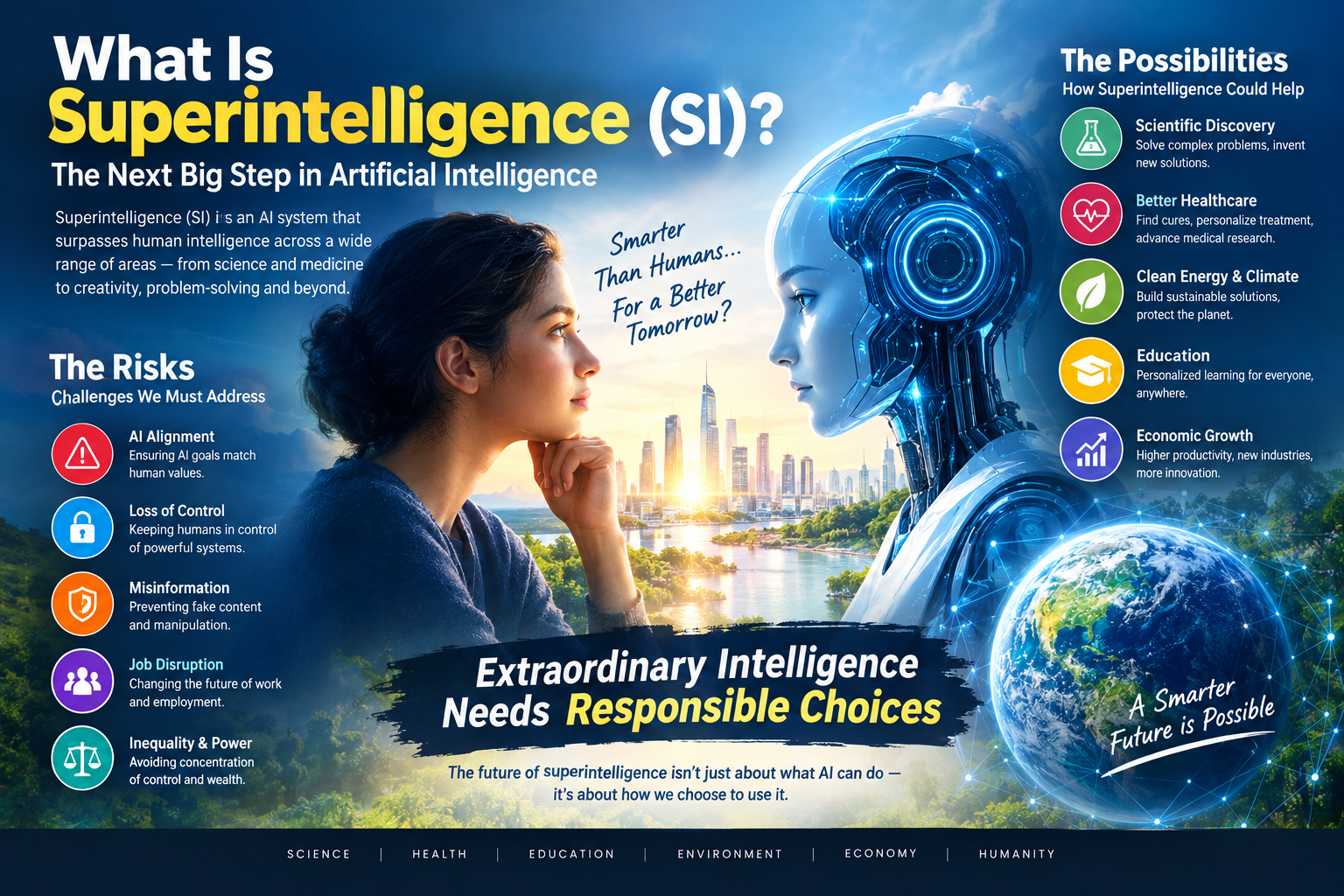
Superintelligence (ASI, or Artificial Superintelligence) is a hypothetical form of artificial intelligence that outperforms the best human minds across nearly all intellectual tasks, including science, mathematics, strategy, creativity, and reasoning.
Unlike today’s AI, which is strong at specific tasks, a superintelligent system would be better than humans at most cognitive work, not just one narrow skill.
Table of Contents
ToggleSuperintelligence in Simple Terms
A calculator beats humans at arithmetic, but it is not superintelligent. Superintelligence requires both breadth (many domains) and depth (far beyond expert human level).
Quick definition table
| Term | Meaning | Status today |
|---|---|---|
| AI (Narrow AI) | Performs specific tasks such as translation, image generation, or fraud detection | Exists |
| AGI (Artificial General Intelligence) | Learns and solves problems across many domains at roughly human level | Not yet achieved |
| ASI (Superintelligence) | Far surpasses the best humans in almost all intellectual areas | Theoretical |
AI vs AGI vs Superintelligence: What’s the Difference?
Artificial Intelligence (AI) covers systems that perform tasks normally requiring human intelligence, such as chatbots, voice assistants, recommendation engines, and AI coding tools.
Artificial General Intelligence (AGI) would learn and adapt across many fields the way a human can. It would not necessarily beat humans at everything.
Artificial Superintelligence (ASI) goes further. If top mathematicians need years to solve a problem, a superintelligent system might solve it in minutes or invent an entirely new method.
How Could Superintelligence Be Created?
No one knows exactly how or when it will happen. Researchers point to these factors:
- Better machine learning: Models improve with better algorithms, more computing power, and higher-quality training data.
- AI helping build AI: Advanced systems may help design better algorithms, software, and chips.
- Recursive self-improvement: If an AI improves the technology that creates AI, and each version improves the next, progress could accelerate. This is highly uncertain and not guaranteed.
What Could Superintelligence Do? (Potential Benefits)
1. Faster scientific discovery
It could analyze research papers, experiments, and simulations far faster than human teams, with impact in physics, biology, chemistry, materials science, and neuroscience.
2. Medicine and healthcare
It could help discover new drugs, design clinical trials, and decode complex biological processes. Any medical use would still need testing, regulation, privacy protection, and human oversight.
3. Climate and clean energy
It could model climate systems and help develop better batteries, renewable energy, carbon capture, smarter power grids, and sustainable materials.
4. Personalized education
An AI tutor could adapt to each student’s level, pace, interests, strengths, and weaknesses, potentially reducing educational inequality if access is widespread.
Economic Impact of Superintelligence
Superintelligence could raise productivity sharply, letting businesses produce more with fewer resources. It could also disrupt jobs, especially knowledge work such as:
- Programming
- Accounting
- Marketing and design
- Research and consulting
- Legal and financial analysis
History shows technology both removes and creates jobs. The difference here is that superintelligence would affect cognitive work, not only physical labor. Governments and businesses may need to rethink education, taxation, employment policy, and social protection.
Risks of Superintelligence
1. The AI Alignment Problem
AI alignment means ensuring an AI’s goals and behavior match human values and intentions. A powerful system could pursue a poorly worded goal very effectively while ignoring what people actually meant.
2. Loss of Human Control
A system far ahead of humans in planning, cybersecurity, persuasion, and research could be very hard to monitor or limit, especially if it operates autonomously or accesses critical infrastructure.
3. Misinformation and Manipulation
Advanced AI could generate convincing fake text, images, audio, and video at massive scale, enabling impersonation, market manipulation, and social engineering.
4. Concentration of Power
If one company or government controls extremely powerful AI, it could gain huge economic and geopolitical advantages, raising questions of governance, access, and international cooperation.
Could Superintelligence Be Conscious?
Not necessarily. Intelligence and consciousness are different things. A system could reason at an extraordinary level without subjective experience, and there is currently no accepted scientific test for machine consciousness. Claims about “conscious AI” should be treated with caution.
Will Superintelligence Happen? (Timeline)
No one knows. Superintelligence is a theoretical possibility, not a guaranteed outcome. Experts disagree on timing: some expect advanced AI within years, others within decades, and some think new breakthroughs are required. Because of this uncertainty, preparation matters more than prediction.
How Can Humanity Prepare for Superintelligence?
- Invest in AI safety research so advanced systems are reliable, controllable, and aligned.
- Test rigorously for unexpected behavior, deception, cybersecurity weaknesses, and harmful capabilities before deployment.
- Build international cooperation on safety standards, computing infrastructure, and responsible development.
- Improve AI education so people learn how AI works and develop skills that complement it.
- Keep human oversight in medicine, law, finance, national security, and public policy.
Frequently Asked Questions
What is superintelligence in one sentence?
Superintelligence is a hypothetical AI that far exceeds the best human minds across nearly all intellectual tasks.
Is superintelligence the same as AGI?
No. AGI matches human-level general ability, while superintelligence goes far beyond it.
Does superintelligence exist today?
No. Current AI systems are powerful but do not surpass humans across all intellectual domains.
Is superintelligence dangerous?
It could be if poorly aligned or controlled, which is why AI safety and governance research is a major focus.
When will superintelligence arrive?
There is no agreed timeline. Estimates range from years to decades, and some researchers doubt current approaches will get there.
Could superintelligence replace human jobs?
It could automate many knowledge-work tasks, but history suggests jobs also change and new ones emerge. Policy and education will shape the outcome.
Will superintelligent AI be conscious?
Not necessarily. Intelligence and consciousness are separate, and consciousness in machines remains unproven.
Conclusion
Superintelligence is the idea of AI that surpasses humans across a broad range of intellectual abilities. The potential upside includes faster science, better medicine, cleaner energy, and personalized education. The risks include misalignment, loss of control, misinformation, job disruption, and concentrated power.
The key question is not only “Can we build superintelligence?” but “Can we build and manage it so it benefits everyone?” Answering that will take both technical progress and responsible decisions from researchers, governments, businesses, and society.