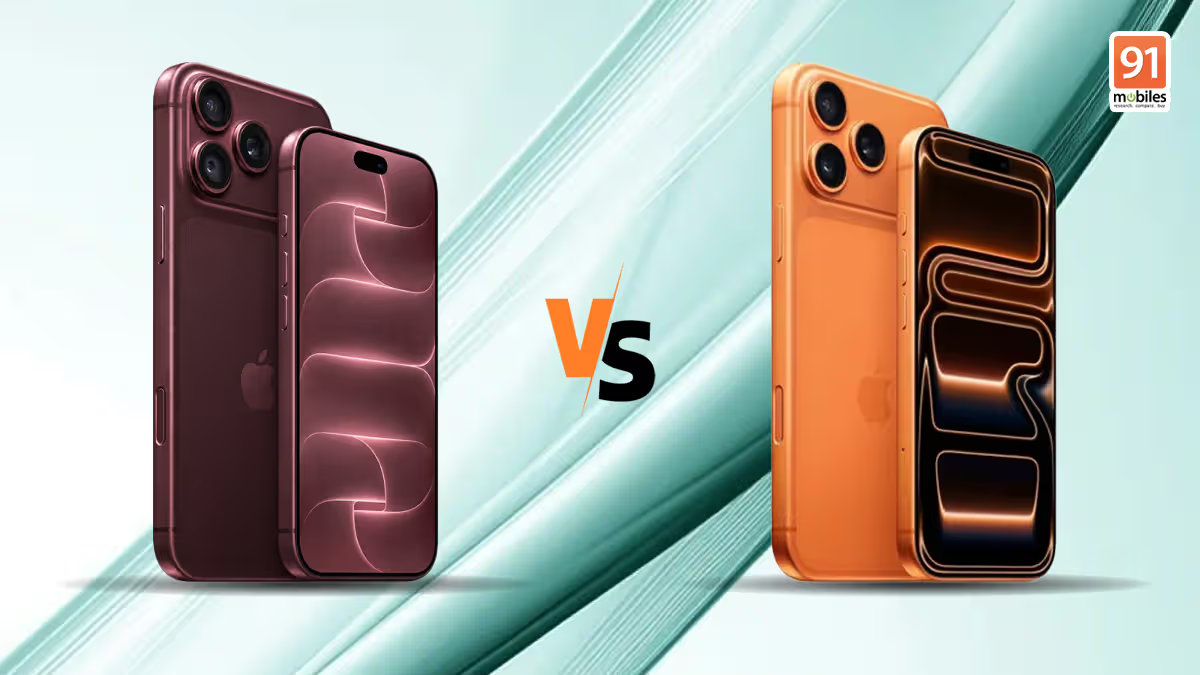
Apple's iPhone 18 Pro is now official, sitting right alongside last year's iPhone 17 Pro on store shelves. For anyone deciding between the newest flagship and the model it replaces, the real question isn't just "what's new" — it's "does any of it matter for how I actually use my phone?" This comparison breaks down every meaningful difference between the two, backed by Apple's own specifications, so you can decide whether the upgrade is worth the money.
Quick Verdict
If you already own an iPhone 17 Pro, this is not an urgent upgrade. The core experience — display size, design, day-to-day speed — is nearly identical. If you're upgrading from an iPhone 15 Pro, iPhone 16 Pro, or earlier, the iPhone 18 Pro represents a much bigger leap, especially in camera flexibility and battery life. First-time Pro buyers should simply go with the 18 Pro, since it's the current flagship with the longest runway of software support ahead of it.
Full Spec Comparison Table
| Feature | iPhone 18 Pro | iPhone 17 Pro |
|---|---|---|
| Chip | A20 Pro chip | A19 Pro chip |
| CPU | 6-core CPU | 6-core CPU |
| GPU | 7-core GPU with Neural Accelerators | 6-core GPU with Neural Accelerators |
| Display | 6.3" Super Retina XDR, ProMotion, Always-On | 6.3" Super Retina XDR, ProMotion, Always-On |
| Rear camera system | 48MP Pro Fusion (Main w/ variable aperture, Ultra Wide, Telephoto) | 48MP Pro Fusion (Main, Ultra Wide, Telephoto), fixed aperture |
| Variable aperture | Yes — ƒ/1.48 to ƒ/4.0 (Fusion Main) | No |
| Front camera | 18MP Center Stage | 18MP Center Stage |
| Battery (video playback) | Up to 34 hours | Up to 31 hours |
| Weight | 211 g | 204 g |
| Build material | Aluminium unibody | Titanium frame |
| Connectivity | USB-C, USB 3 (20x faster transfers) | USB-C, USB 3 (20x faster transfers) |
| Water resistance | IP68, 6m for 30 min | IP68, 6m for 30 min |
| Apple Intelligence / Siri AI | Yes | Yes |
| Availability | Pre-order / new | Available at authorised resellers |
Design and Build Quality
Both phones share the same 6.3-inch footprint and the Dynamic Island up front, so visually they're easy to mix up. The one change worth noting is materials: the iPhone 18 Pro moves to an aluminium unibody, while the iPhone 17 Pro uses a titanium frame. Titanium is prized for its strength-to-weight ratio and premium feel, so some buyers may actually prefer the older phone's build here — this is one of the rare cases where "newer" doesn't automatically mean "better" on paper. The trade-off is usually thermal performance and repairability, where aluminium unibody designs can have an edge.
Both phones keep the Action Button, Camera Control, Ceramic Shield 2 front glass, and IP68 water resistance rated to 6 metres for 30 minutes.
Display: No Real Change
If you're hoping for a jump in screen technology, there isn't one this cycle. Both phones use a 6.3-inch Super Retina XDR display with:
- ProMotion (adaptive refresh up to 120Hz)
- Always-On display
- 2,000,000:1 contrast ratio
- 3,000 nits peak outdoor brightness
- Same resolution (2622x1206 at 460ppi)
This is a case where Apple clearly decided the display was already good enough and put its engineering budget elsewhere — namely, the chip and camera.
Chip and Performance
The iPhone 18 Pro's A20 Pro chip replaces the A19 Pro, and it comes with a 7-core GPU compared to the 17 Pro's 6-core GPU — both with Neural Accelerators and hardware-accelerated ray tracing. In practice, this means:
- Faster sustained performance in graphically demanding games
- Quicker on-device Apple Intelligence processing (image generation, writing tools, Siri AI requests)
- Slightly better efficiency, which likely contributes to the improved battery life
For everyday tasks — browsing, messaging, social media, streaming — the difference between an A19 Pro and A20 Pro is not something most people will notice. This upgrade mainly benefits power users: mobile gamers, video editors working natively on iPhone, and anyone leaning heavily on on-device AI features.
Camera: The Biggest Real-World Difference
This is where the iPhone 18 Pro earns its "Pro" name most convincingly. Both phones share the same 48MP Pro Fusion triple-camera layout (Main, Ultra Wide, Telephoto), the same Photographic Styles, and the same Dolby Vision video recording up to 4K at 120fps. But the 18 Pro adds a variable aperture on the Fusion Main lens — ƒ/1.48, ƒ/1.8, ƒ/2.8, and ƒ/4.0 — a feature that was previously reserved for niche camera-first phones from other brands.
What this means practically:
- Wider apertures (ƒ/1.48) let in more light for low-light shots and produce a shallower depth of field for portraits without relying purely on software blur.
- Narrower apertures (ƒ/4.0) are useful in bright daylight, giving photographers more control over exposure and depth of field without needing an ND filter.
- Videographers get more manual control comparable to a mirrorless camera, useful for anyone shooting run-and-gun content for YouTube or Instagram.
The iPhone 17 Pro's camera is still excellent, and casual users comparing photos side by side likely won't see a dramatic difference in typical daylight or auto-mode shots. But for anyone who shoots manually, in mixed lighting, or wants more creative control, the 18 Pro's variable aperture is a genuine, tangible upgrade — not just a marketing bullet point.
Battery Life
The iPhone 18 Pro rates for up to 34 hours of video playback, versus 31 hours on the iPhone 17 Pro. That three-hour gain likely comes from a combination of the more efficient A20 Pro chip and possibly a slightly larger battery cell, though Apple doesn't publish exact battery capacities. In real-world use, expect this to translate into an extra hour or two of typical mixed use (calls, browsing, camera, streaming) across a full day, rather than a transformative difference.
Weight and Portability
Here's a genuine downside for the 18 Pro: it weighs 211 grams, compared to 204 grams for the 17 Pro. It's a small difference — about the weight of a couple of coins — but if you're sensitive to phone weight (one-handed use, pocket comfort, or long photography sessions holding the phone up), it's worth noting that the newer phone is not lighter, it's marginally heavier.
Connectivity and Charging
No changes here — both phones use USB-C with USB 3 support for up to 20x faster wired transfers compared to USB 2, and both support MagSafe wireless charging up to 25W with a 30W (or higher) adapter. If you already own an Apple or third-party charging setup for the 17 Pro, it will work identically with the 18 Pro.
Software and AI Features
Both phones run the same current software generation and support Apple Intelligence and Siri AI, Apple's more conversational and personal assistant experience. Since these are software features tied to the OS rather than exclusively to the new chip, most capabilities will be shared across both phones — though the 18 Pro's extra GPU headroom may mean marginally faster on-device processing for AI tasks over time as Apple Intelligence features grow more demanding.
Price and Availability
The iPhone 18 Pro is currently available to pre-order directly from Apple as the new flagship. The iPhone 17 Pro has moved to "available at authorised resellers" status, meaning Apple has stopped selling it directly — a strong hint that stock will thin out and pricing may fluctuate at third-party retailers as it's phased out.
Should You Upgrade? A Practical Breakdown
- You own an iPhone 17 Pro: Skip this cycle unless the variable aperture camera specifically matters to your photography or video work. The chip, display, and battery gains are incremental, not transformative.
- You own an iPhone 16 Pro or older: This is a strong upgrade — you'll notice the chip speed, the extra battery life, and especially the camera flexibility.
- You're buying your first Pro-tier iPhone: Go with the iPhone 18 Pro. It's the current flagship, will receive the longest run of iOS updates, and includes the newest camera hardware.
- You care more about premium materials than camera specs: The iPhone 17 Pro's titanium frame may actually appeal to you more than the 18 Pro's aluminium unibody — this is a rare instance where "previous generation" wins a specific category.
Final Thoughts
The iPhone 18 Pro is a solid, if not dramatic, step forward from the iPhone 17 Pro. The standout addition — the variable aperture camera — is a meaningful upgrade for anyone serious about mobile photography, while the new chip and battery life improvements offer modest, real-world benefits. If you're not already glued to your 17 Pro, and you're due for an upgrade, the 18 Pro is the safer long-term buy. But if your 17 Pro is doing everything you need, there's no pressure to switch this year.
All specifications sourced from Apple's official iPhone compare page.