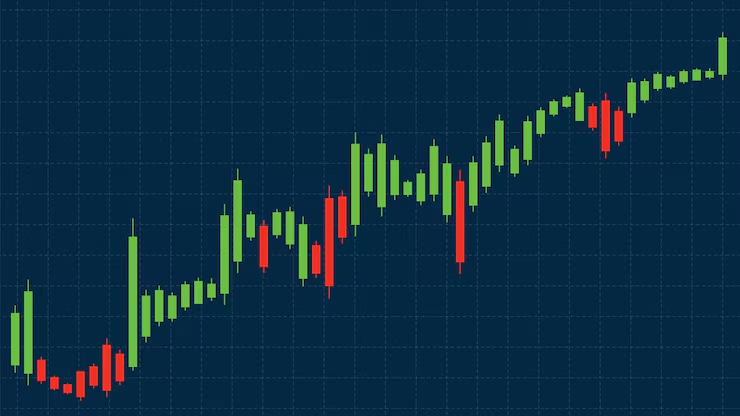
The stock market can seem complicated when you first hear terms like shares, dividends, market capitalization, P/E ratio, brokers, and stock exchanges. But the basic idea is actually quite simple.
The stock market is a marketplace where investors can buy and sell ownership in publicly listed companies.
If you are interested in building wealth and improving your financial knowledge, understanding how the stock market works is an important first step.
Table of Contents
ToggleWhat Is the Stock Market?
A stock represents a small ownership share of a company.
For example, imagine a company has 1 million shares. If you own 1,000 shares, you own a small portion of that company.
Companies sell shares to investors to raise money. Investors purchase those shares because they hope the value of their investment will increase or that the company will pay dividends.
Stocks are bought and sold through organized stock exchanges.
For example:
- 🇺🇸 New York Stock Exchange (NYSE)
- 🇺🇸 Nasdaq
- 🇬🇧 London Stock Exchange (LSE)
- 🇱🇰 Colombo Stock Exchange (CSE)
Why Do Companies Sell Shares?
Businesses need capital to grow.
A company may want money to:
- Build new factories
- Open new branches
- Develop new products
- Purchase equipment
- Expand internationally
- Reduce debt
One way to raise this money is by selling shares to the public.
This is commonly done through an Initial Public Offering (IPO).
After the shares become publicly traded, investors can buy and sell them on the stock exchange.
How Do Investors Make Money?
There are two main ways investors can potentially make money from stocks.
1. Capital Gains
This happens when you buy a stock at a lower price and later sell it at a higher price.
For example:
You buy 100 shares at $10.
Investment = $1,000
Later, the share price increases to $15.
Value = $1,500
Your potential gain is:
$1,500 − $1,000 = $500
However, stock prices can also fall. If the price drops to $7, your investment would be worth $700.
That is why investing always involves risk.
2. Dividends
Some companies distribute part of their profits to shareholders.
These payments are called dividends.
For example, if a company pays a dividend of $0.50 per share and you own 1,000 shares:
1,000 × $0.50 = $500
You would receive $500 in dividends, subject to the company’s dividend policy and applicable taxes.
Not every company pays dividends. Some companies reinvest their profits into growing the business.
What Makes Stock Prices Go Up and Down?
Stock prices change because buyers and sellers constantly interact in the market.
When more investors want to buy a stock than sell it, the price can rise.
When more investors want to sell than buy, the price can fall.
Many factors influence investor demand, including:
Company Performance
If a company’s profits and revenue are growing, investors may become more optimistic about its future.
Economic Conditions
Interest rates, inflation, economic growth and currency movements can affect businesses and stock prices.
Company News
Announcements about new products, acquisitions, management changes, lawsuits or major contracts can influence prices.
Investor Sentiment
Sometimes investors buy or sell based on expectations and emotions rather than current financial results.
Fear and greed can create significant short-term price movements.
What Is a Stock Exchange?
A stock exchange is an organized marketplace where securities can be traded.
For example, in Sri Lanka, publicly listed companies are traded through the Colombo Stock Exchange (CSE).
The exchange provides the infrastructure and rules that allow buyers and sellers to participate in the market.
What Is a Stock Broker?
Most investors don’t directly connect to the stock exchange.
Instead, they use a stockbroker.
A broker provides access to the market and allows investors to place orders to buy or sell shares.
The general process looks like this:
Investor → Broker → Stock Exchange → Market
For example, if you want to buy shares:
- Open an investment account with a broker.
- Deposit funds.
- Select a company.
- Enter the number of shares you want to buy.
- Place your order.
- If a matching seller is available, the trade can be executed.
What Is a Market Order?
A market order instructs your broker to buy or sell immediately at the best available market price.
For example:
You want to buy 100 shares immediately.
You place a market order, and the broker attempts to execute the purchase using available sell orders.
The final price may differ slightly from the price you saw before placing the order.
What Is a Limit Order?
A limit order allows you to specify the maximum price you are willing to pay when buying, or the minimum price you are willing to accept when selling.
For example:
A stock is trading around $20.
You place a limit order to buy at $18.
Your order will generally execute only if shares become available at your specified price or better.
What Is a Bull Market?
A bull market generally describes a period when stock prices are rising and investor confidence is strong.
Investors may expect economic and corporate conditions to improve.
What Is a Bear Market?
A bear market generally describes a prolonged period of falling prices and weak investor sentiment.
Investors may become concerned about economic conditions, company earnings or other risks.
Investing vs. Trading
These two approaches are often confused.
Investing
Investors generally purchase companies with the intention of holding them for a longer period.
They may focus on:
- Revenue growth
- Profitability
- Cash flow
- Competitive advantages
- Management
- Dividends
- Valuation
Trading
Traders generally focus more heavily on shorter-term price movements.
They may use:
- Price charts
- Technical indicators
- Trading volume
- Support and resistance
- Momentum
- Market trends
Neither approach guarantees profits. The right approach depends on your goals, knowledge, risk tolerance and time horizon.
Important Stock Market Terms
Here are some terms every beginner should understand.
Market Capitalization
The total market value of a company’s outstanding shares.
EPS — Earnings Per Share
The company’s earnings attributable to each outstanding share.
P/E Ratio — Price-to-Earnings Ratio
A valuation measure comparing a company’s share price with its earnings per share.
Dividend Yield
The annual dividend expressed as a percentage of the share price.
Book Value
The accounting value of a company’s net assets.
P/B Ratio — Price-to-Book Ratio
A measure comparing the market price of a company with its book value.
Volume
The number of shares traded during a particular period.
Volatility
The degree to which a stock’s price fluctuates.
Why Do People Lose Money in the Stock Market?
Investing isn’t guaranteed to make money.
Some common mistakes include:
- Buying without researching the company
- Following social-media rumors
- Investing money they cannot afford to lose
- Using excessive leverage
- Panic selling
- Buying because a stock has recently risen sharply
- Putting all their money into one company
- Ignoring valuation
- Making emotional decisions
One of the most important investing skills is learning to control emotions.
How Can a Beginner Start?
A simple starting process is:
Step 1: Learn the Basics
Understand stocks, dividends, valuation, risk and diversification.
Step 2: Define Your Goal
Ask yourself why you are investing.
Are you investing for:
- Retirement?
- Long-term wealth?
- Additional income?
- A specific financial goal?
Step 3: Research Companies
Before buying a stock, study the company’s business and financial performance.
Look at revenue, earnings, debt, cash flow, valuation and future growth prospects.
Step 4: Diversify
Avoid putting your entire investment into one company.
Diversification can help reduce the impact of a single investment performing poorly.
Step 5: Think Long Term
Successful investing is usually more about consistency and discipline than trying to predict every daily price movement.
Final Thoughts
The stock market is not simply a place where prices move up and down. It is a marketplace where investors buy ownership in businesses.
The key to becoming a better investor is to understand what you are buying, why you are buying it, how much you are paying, and what risks you are taking.
Start with education rather than trying to get rich quickly.
Build your financial knowledge. Build your wealth. Build your future — before 30.